 Denys Mitchell
Key Takeaways
- A coil element plugs in like a lamp — a dead burner on a coil cooktop is worth fixing at essentially any age.
- Cracked ceramic glass ends a radiant or induction cooktop: the surface is structural and seals the electronics beneath it.
- Induction power modules are worth replacing under eight years and rarely after, because the remaining modules are the same age.
- One zone dead means a contained repair; all zones dead means the control side or a lost breaker leg.
- A zone that will not switch off is a reason to kill the circuit now, not to wait for an appointment.
The Bottom Line
Repair a coil cooktop at any age. Replace a radiant or induction top with cracked glass. For induction modules, eight years is the line.
Whether to repair or replace a Whirlpool cooktop depends on which of three quite different appliances you own — coil, radiant glass, or induction — because the answer is different for each. A coil cooktop is almost always worth fixing. An induction one usually is, until it is suddenly not. Knowing which you own is the first half of the decision.
| What failed | Coil | Radiant glass | Induction |
|---|---|---|---|
| One zone dead | Repair — often plug-in | Repair | Repair under 8 years |
| Control knob or switch | Repair | Repair | Not applicable |
| Touch panel unresponsive | Not applicable | Repair | Repair |
| Cracked glass surface | Not applicable | Replace | Replace |
| Power module failure | Not applicable | Price both ways | Replace past 8 years |
Coil Cooktops Are the Easy Case
A coil element plugs into a receptacle the way a lamp plugs into a socket. When one stops heating, the element itself is usually the fault, and swapping it takes minutes with no tools. The receptacle behind it is the next suspect, and that is a contained repair too.
There is no glass to crack and no touch panel to fail. For that reason a coil cooktop is worth repairing at essentially any age — the parts are cheap, universal, and still made. If you have one and one burner is dead, do not replace the appliance.
Cracked Glass Ends a Radiant or Induction Cooktop
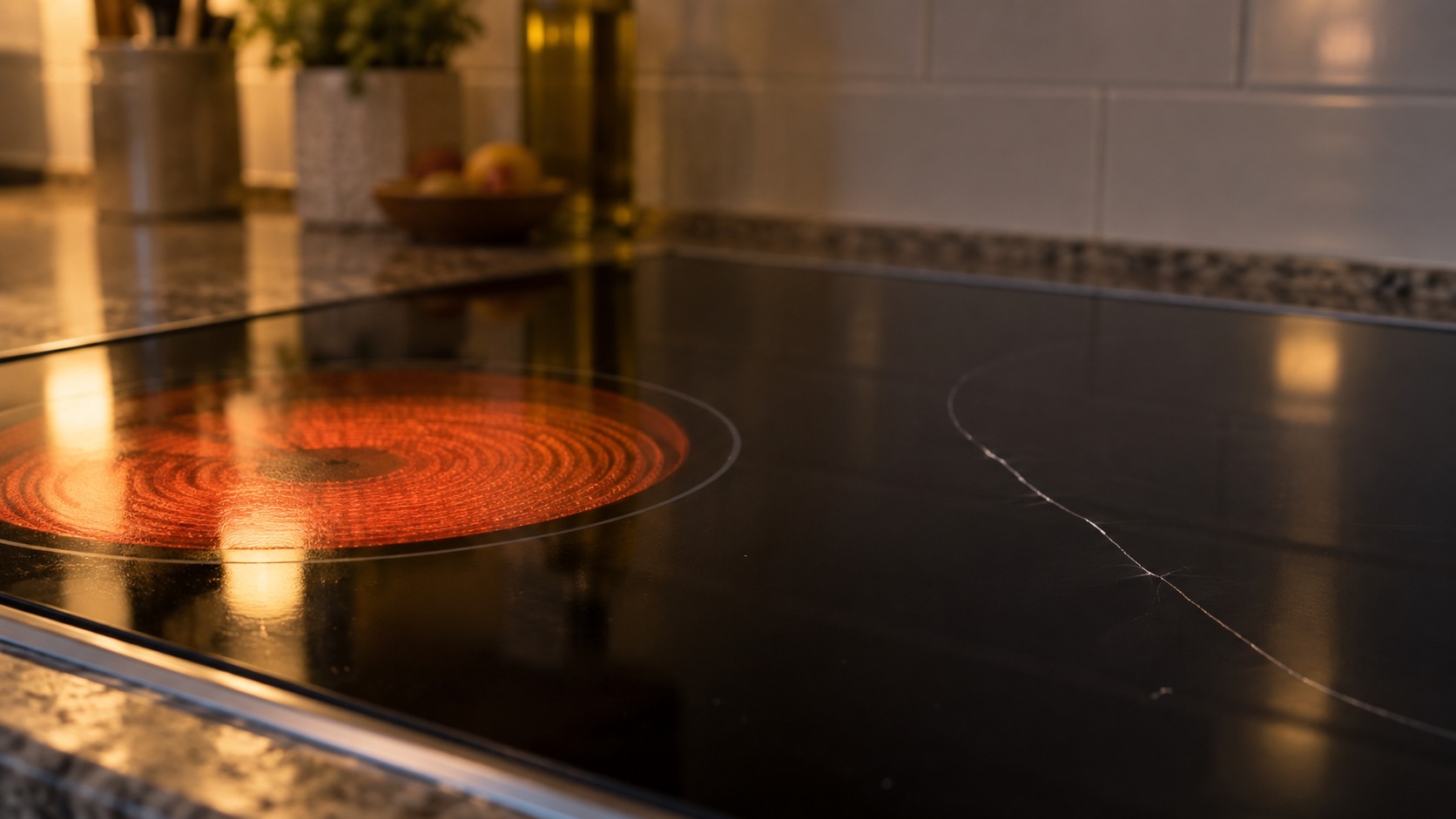
The ceramic surface is not a cosmetic panel. It is the structural top of the appliance and the seal that keeps spills out of the electronics underneath. A crack that reaches a zone lets liquid through to live components, which is a safety matter rather than an appearance one.
Replacing the glass means a new surface assembly, and on most models that single part carries a large share of the cost of a new cooktop. This is the clearest case on the whole table: cracked glass means replace.
Induction Turns on the Eight-Year Mark
Induction cooktops carry a power module for each zone or pair of zones, and those modules are the expensive components. Under eight years, replacing one is generally worth it — the glass is intact and the rest of the appliance has life left.
Past that point the arithmetic changes, because the remaining modules are the same age and have run the same hours. Paying for one module on a ten-year-old induction top often means paying for another within a couple of years.
One Zone or All of Them?
This single observation sorts most faults before anyone opens anything.
- One zone dead, the rest normal. Element, switch, or a single connection — contained and worth repairing.
- All zones dead, panel lit. Control side: relay board or main control.
- All zones dead, panel dark. Check the breaker first — cooktops often run on a double-pole breaker and can lose one leg.
- Zones cutting out under load. On induction, that is thermal protection working; on radiant, it is the infinite switch cycling normally.
Look up whatever the surface is reporting in the Whirlpool cooktop error code archive before deciding — a code affecting one zone is good news, and a code affecting the whole surface is not.
Do Not Keep Using a Faulty Cooktop
A zone that will not switch off, a surface that stays hot after everything is turned down, or visible cracking around a zone are reasons to shut off the circuit and stop, not to wait for a convenient appointment. These faults do not improve on their own.
- Identify the type: coil, radiant glass, or induction.
- Note whether one zone or all are affected.
- Inspect the glass closely in daylight for hairline cracks.
- Check the age — eight years is where the induction decision turns.
Getting a Real Answer
Our Whirlpool cooktop repair service covers coil, radiant and induction models, and diagnostics starts from $89 — which on a cooktop usually settles the question in one visit, because the failure is either in one zone or in the control and a meter tells them apart quickly.
The final price is confirmed after the on-site diagnosis, with a written estimate before any work begins. Book a visit with the type and the symptom noted.