 Denys Mitchell
Key Takeaways
- F1E1 means the sensor on the main control board has failed; F2E1 is usually a damp or stuck keypad that can be dried out.
- Check the door seal and harness connectors before the board, because a leak or loose plug can imitate a failed board.
- F3E1 and F7E1 point at a sensor and a heating element, not at the board.
- Under about 7 years old, repair the board; between 7 and 9, compare against half the price of a new unit; past 9, lean toward replacing.
- A board repair that comes alongside other recent repairs usually argues for replacing the machine.
The Bottom Line
Dry out and test a stuck keypad first, and rule out a leaking door seal before blaming the board. Then let age decide: repair when young, compare around seven to nine years, replace when older.
A control board is the part of a dishwasher that most often turns a routine repair into a replacement conversation, and it is also the part that gets blamed too quickly. Two Whirlpool codes sit close to the board, F1E1 and F2E1, and they lead to very different bills. One is a keypad that got damp, and the other is a sensor on the board itself. Sorting out which you have, and how old the machine is, settles most of the decision before a technician arrives.
| What the dishwasher is doing | What it points to | Board replacement likely? |
|---|---|---|
| F1E1, returns after a power reset | Temperature sensor on the main control board has failed | Yes, unless a loose harness or a leaking door seal is found first |
| F2E1, will not start, beeps or cycles by itself | Stuck keypad button, often moisture under the membrane | Often not; dry and clean the panel first |
| F3E1, cold dishes, cycle stops | Water temperature sensor open | No, it is a separate sensor |
| F7E1, wet dishes after the dry phase | Heating element or its circuit | No, rule the element out first |
When Is the Control Board Actually the Problem?
When a code points at the board's own circuits and keeps coming back after a breaker reset, or when the panel goes dead with no code at all. Most other Whirlpool dishwasher codes point at a sensor, a heater or a pump rather than at the board, so a board replacement ordered on a hunch is a common way to pay twice.
- Code returns within one cycle of a reset — a persistent hardware fault, not a transient glitch.
- Control panel unresponsive — buttons stop working because the board locks out inputs after the fault.
- Burning-plastic smell near the panel or a tripped breaker — stop using the machine and have it inspected.
- Water or mineral deposits near the control housing — the board may be a victim of a leak rather than the original fault.
What Does F1E1 Mean on a Whirlpool Dishwasher?
It means the internal temperature sensor on the main control board has failed, so the board can no longer verify its own operating conditions. Our dishwasher F1E1 page rates it high severity and says the dishwasher cannot complete a wash cycle while the code is active. Repeated attempts risk overheating the pump motor and worsening the fault.
Two cheaper causes are worth checking before the board is condemned. A connector that has vibrated loose can make the sensor reading look intermittent, and a leaking door seal can let steam or water reach the board and corrode the contacts. The code page's advice is to replace a damaged door gasket before replacing the board, since a new board in a wet housing fails the same way.
Can a Stuck Keypad Be Fixed Without a New Board?
Often yes. F2E1 reports a key that the board believes is held down, and moisture under the keypad membrane or a warped button is the usual reason. With the dishwasher off, wipe the panel with a lightly dampened microfiber cloth, spraying the cleaner onto the cloth and never onto the panel, then dry it immediately. A five-minute breaker reset and a firm press of each button in turn can free a sticky key. Our dishwasher F2E1 page lists the steps in full.
The exception is a failed user interface board, which reports a stuck key that does not exist and needs a professional. If liquid is visible behind the panel or a button is physically broken, stop and book a visit rather than pressing on.
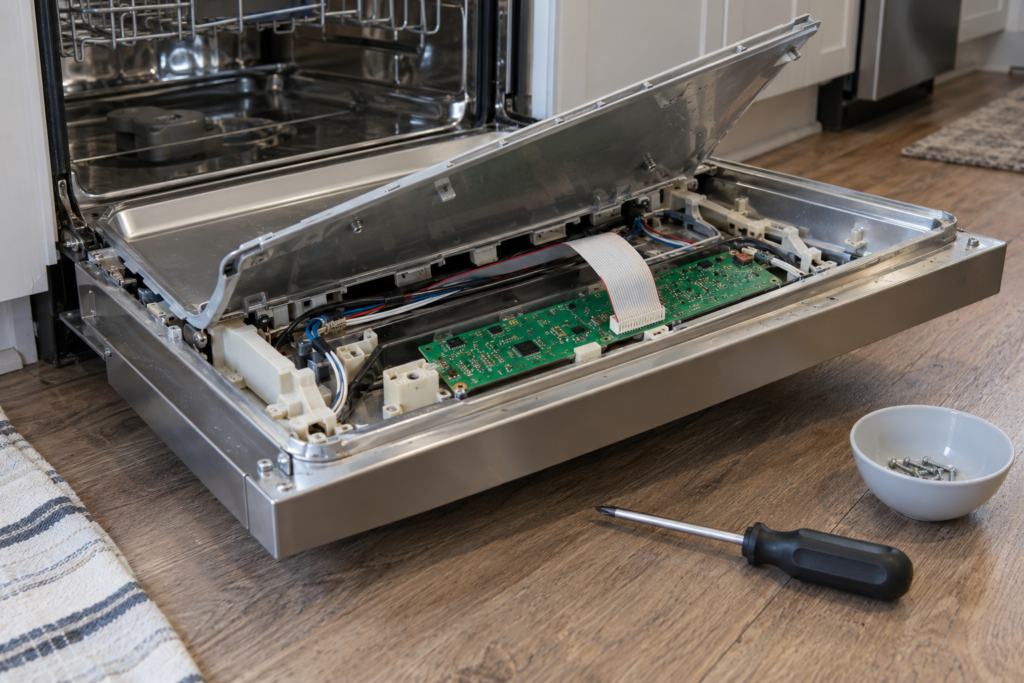
What to Rule Out Before Buying a Board
The expensive part should be the last one you buy. Several codes that feel like electronics are really a sensor, a heater or a latch, and each of those is a smaller repair. Our dishwasher diagnostic codes guide lists the full set.
- Door seal and hinge wiring — look for steam marks, mineral deposits and pinched wires near the lower hinge.
- Harness connectors at the board — a plug that has worked loose imitates a failed sensor.
- Other codes on the display history — F3E1 and F7E1 point at a sensor and a heating element, not at the board.
- Warranty status — the F1E1 page notes that WDT and WDTA series coverage may include control board faults, and a technician can file the claim.
Whirlpool Dishwasher Control Board Repair vs Replacement: Which Is It?
Repair it under about seven years old, evaluate carefully between seven and nine, and lean toward replacing the dishwasher past nine, according to this site's repair-or-replace guide. When you weigh a Whirlpool dishwasher control board repair vs replacement, the figure that matters is the board's cost against the 50 percent mark: if the board plus labor approaches half the price of a new dishwasher on an older machine, the repair rarely pays back.
The site prices a control board repair from $230, which is why it is called the most expensive single dishwasher repair and the one that most often triggers a replacement discussion. Dishwashers have a shorter lifespan than other major appliances, about 9 to 12 years on this site's numbers, so a board that fails at year nine buys a short second life. Our parent guide, Whirlpool dishwasher repair or replace, covers the other parts of the machine.
Counting the Whole Bill
Look at the machine's recent history, not only at this fault. Dishwashers fail in clusters because the pumps, hoses, seals and board all live in the same hot, humid, detergent-rich environment. If the door gasket, the drain pump and a spray arm have all been replaced within two years, the board is probably not the last repair you will pay for.
- Under seven years, first fault — repair the board; the rest of the machine has years left.
- Seven to nine years — get a written estimate and compare it with half the price of a new unit.
- Over nine years — lean toward replacing, especially if this is the second major repair.
- A leak caused the fault — fix the seal first, or the new board will meet the same fate.
Our is it worth repairing a Whirlpool dishwasher guide gives the same framework for the machine as a whole.
Getting a Diagnosis Before You Decide
A technician can confirm a board failure with a multimeter rather than by replacing parts until the code stops, and that confirmation is what you are paying for. The Whirlpool dishwasher repair page describes the visit. The final price is confirmed after diagnosis, with a written estimate before any work begins, so you can compare it against the age rules above before agreeing. Book a visit or send us the model number, the code and how old the machine is.