 Denys Mitchell
Key Takeaways
- F3E1, F5E2, F7E1 and F7E5 each list a control board fault, and on every page it comes after cheaper parts.
- A board should be diagnosed only after the sensor, lock or actuator on the code page has been tested.
- On a washer under about 8 years old with a confirmed board fault, a new board is usually worth fitting.
- Over 11 years old, or after a second repair in 18 months, put the quote beside the price of a new washer.
- Ask for the written estimate with the board and labor on separate lines.
The Bottom Line
Make the technician show that the cheaper parts tested good before a board is ordered. Then fit it on a younger washer, or compare it with a new machine on an older one.
A technician who says the control board has failed has handed you the most expensive-sounding sentence in washer repair, and it deserves a second look before you accept it. The choice behind a Whirlpool washer control board repair vs replacement quote is really two choices: whether the board is truly the fault, and whether this washer deserves a new one. This guide covers both for WTW top-load and WFW front-load models, and the parent Whirlpool washer repair or replace guide covers the machine as a whole.
| Option | Fits when | Watch for |
|---|---|---|
| Fit a new control board | Washer under about 8 years old, board is the confirmed fault, no other repairs recently | A board diagnosed without ruling out the cheaper parts on the code's list |
| Fix the cheaper part first | The code names a sensor, relay circuit or actuator that has not been tested yet | A quote that skips the test and goes straight to the board |
| Replace the washer | Over 11 years old, a second repair in 18 months, or the board is one of several faults | Spending half the price of a new machine on an old one |
Which Whirlpool Washer Codes Point at the Control Board?
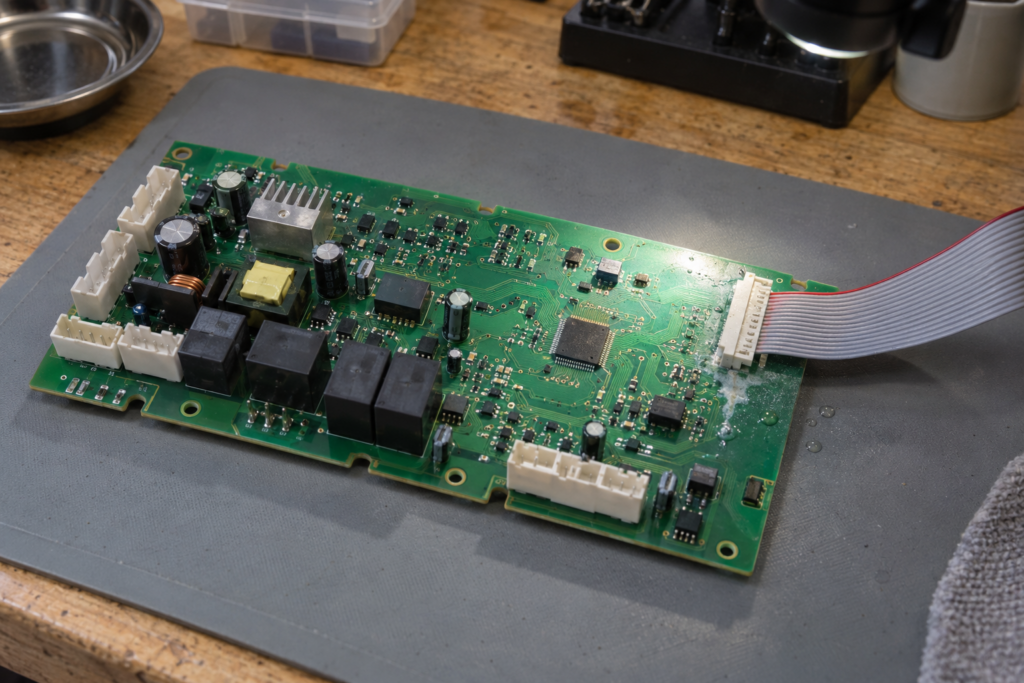
Four codes on our washer pages list a board fault among their causes, and in each case it comes last. That ordering is the useful part: on every one of these pages a cheaper part is listed first, and the board is the answer only when the others test good.
- F3E1 — a water temperature sensor fault; the board is the suspect when a faulty analog input misreads a good thermistor as open or shorted.
- F5E2 — a door lock fault on front-loaders; a failed relay on the board that does not power the lock solenoid is the board-side cause.
- F7E1 — a motor speed sensing fault; a failed inverter or drive circuit on the motor control board keeps the motor from reaching speed.
- F7E5 — a shifter actuator fault on top-loaders; the board circuit that powers the actuator motor may have failed.
The F7E1 page notes that a power reset may clear a transient code but that mechanical or electrical failures return on the next spin. A code that clears and returns is a reason to keep testing, not to order a board.
Is a New Board Worth It on a Washer Under Eight Years Old?
Usually yes, provided the board is confirmed as the fault. Our parent guide says Whirlpool washers average 11 to 14 years of service and that a washer under 8 years old should almost always be repaired for common faults, and it lists a main control board from $250 in its cost guide. Set that against the 50 percent rule, which says a repair that costs more than half of a comparable new washer rarely makes sense, and a younger machine clears the bar comfortably.
The key phrase is confirmed. On a younger washer the board is rarely the first thing to fail, so a quote that names it without a test is a reason to ask for the test result.
- Ask which part was tested — the thermistor, lock, sensor or actuator named on the code page should have been checked before the board.
- Ask what the meter showed — a good reading on the cheap part is the evidence that points at the board.
- Ask whether the board is the whole cost — motor control boards and main boards are different parts with different prices.
When Does a Control Board Failure Mean Replacing the Washer?
When the board is one more sign that the machine is wearing out, and not a one-off. Our parent guide gives three triggers: age over about 11 years, a second significant repair within 18 months, and a failure type such as a transmission, bearing or control board, which it groups on the replace side of its table.
A board failure on a 12-year-old washer that has already needed a pump and a lid switch is a different decision from the same board on a 5-year-old one. The first suggests the washer is at the end of its life, and the second suggests an isolated fault. Replacing the machine also means you need a replacement unit installed, so factor that in before comparing totals.
- Age over 11 years — the board may outlast the rest of the machine by very little.
- Second repair in 18 months — the parent guide calls this a clear signal to replace.
- Other faults showing — bearing noise, a leaking tub or a persistent odor mean the repair buys little.
Questions to Ask Before Agreeing to a New Board
Ask the technician to name the code, the cheaper parts that were ruled out and the part number of the board. A washer's boards differ by model, and ordering the wrong one is a costly mistake. Then ask for the written estimate, which should show the board and labor on separate lines.
- Which code and when it appears — a code at power-on and one that appears at the start of spin point at different circuits.
- Which tests were done — the answer should name the sensor, lock or actuator checked before the board.
- Whether a reset cleared it — a transient code is not a failed board.
What Can Make a Good Board Look Bad?
Several faults on our code pages produce a symptom that points at the board while the board is fine, and ruling them out is cheaper than a new board.
- A blocked or disconnected pressure sensor hose — the F8E1 page says this makes the board misread the water level and believe the tub is not filling.
- A loose or corroded connector — the F3E1 page notes that vibration and moisture can loosen a thermistor connector and break the circuit intermittently.
- Debris in the actuator area — the F7E5 page lists a coin or button that blocks the actuator arm as a possible cause.
- Pinched or broken wires — the wires that run to the sensor bars can be damaged by repeated drum movement, as the F3E2 page explains for combination models.
Each of these is a repair for a part or a wire rather than a board, and each looks, at first glance, like an electronic fault.
Making the Call
On a younger washer with a confirmed board fault, fit the board and keep the machine. On an older one with other faults, put the quote beside the price of a new washer and decide on the 50 percent rule. Our washer repair costs guide lists the cost of each part, and washer F codes explained helps you read the code before the visit. The washer repair page covers what a visit includes.
The final price is confirmed after the on-site diagnosis, with a written estimate before any work begins. Book a visit or send us the model number and the code so the technician arrives with the right tests ready.