 Denys Mitchell
Key Takeaways
- The sensor part starts from $20; the typical F3E0 repair on our code page starts from $240.
- F3E0 means the board reads an open circuit from the oven temperature sensor, and a reset will not clear it.
- A healthy probe reads roughly 1,080 to 1,090 ohms at room temperature; an open reading means it has failed.
- A wall oven can cost from $30 more in labor because the oven may have to come out of its cabinet.
- If the sensor and wiring both test good, the board input is next, and a control board starts from $250.
The Bottom Line
A sensor swap is one of the cheaper oven repairs, so check the probe and wiring before a board is blamed. Final price comes after a diagnosis on site, with a written estimate first.
The probe that reads oven temperature is a small, cheap part that does a big job: the control board decides when to heat and when to stop based on what it reports. When it fails, the oven can refuse to heat at all or cook at the wrong temperature, and the bill that follows depends far more on the type of oven and the access to the back wall than on the part itself. This guide sets out what a Whirlpool oven temperature sensor replacement cost looks like and which parts of the quote are worth questioning.
| Item | What it involves | Starting price |
|---|---|---|
| Diagnostic visit | Reading the code, testing the sensor and its wiring | from $89 |
| Sensor part only | Replacement probe, listed for WFE, WFG, WOS and WOD ovens | from $20 |
| Repair for an F3E0 sensor fault | Typical repair figure on the F3E0 code page | from $240 |
| Extra labor on a wall oven | Pulling the oven partly out of its cabinet to reach wiring | from $30 more |
| Control board | Only when the sensor and wiring both test good | from $250 |
How Much Does a Whirlpool Oven Temperature Sensor Replacement Cost?
The probe itself starts from $20 in parts, and the repair figure on our F3E0 page starts from $240. The gap between the two is labor, the diagnostic visit, and the small amount of access work around the back wall of the cavity. The final price is confirmed after a diagnosis on site, with a written estimate before any work begins, so treat every figure here as a starting point rather than a quote.
Our general Whirlpool oven repair costs guide lists the temperature sensor among the least expensive oven parts, in the same bracket as a thermal fuse and well below an igniter or a control board. That ranking is the useful part: a sensor replacement is almost never the repair that makes an oven not worth keeping.
An itemized estimate makes the price easy to judge, and three lines should be on it.
- The part named — "temperature sensor" or "RTD probe", not just "oven repair", so you know what was tested and found faulty.
- The labor — shown separately from the part, with any wall-oven access time listed on its own line.
- The test result — a probe that reads open on a meter is the evidence for the sensor, and it costs nothing to ask for.
What Does F3E0 Mean on a Whirlpool Oven?
It means the control board cannot read a valid resistance from the oven temperature sensor, which our oven F3E0 page describes as a bake temperature sensor open circuit. The sensor is a resistance probe, and a burned-out probe, a damaged lead or a fault on the board input all look the same to the board: an open circuit with no usable reading.
- Oven fails to heat — the board will not energize the bake or roast element without temperature feedback.
- Code at power-on — F3E0 appears as soon as power returns, before any cooking function is chosen.
- Cycle cancels within seconds — the board starts the cycle, sees the open sensor and aborts.
- Blank or dashed temperature display — no valid data is reaching the board.
The page marks F3E0 as high severity and says not to use the oven until the sensor is replaced, because without a working sensor the oven cannot regulate heat. A power reset does not clear it, since the fault is in hardware.
Can You Tell Whether It Is the Sensor, the Wiring or the Board?
Partly, and the order of the tests is what keeps the bill down. The F3E0 page lists the sensor first, the wiring harness second and the board's sensor input third, and only the first two are marked as possible for a competent owner. The test it describes is a resistance reading across the probe terminals with the oven disconnected from power.
- Healthy sensor — the page gives roughly 1,080 to 1,090 ohms at room temperature.
- Open loop or very low reading — an open circuit, or a reading below about 500 ohms, means the sensor is bad.
- Good reading, code stays — the harness or the board input is the suspect, and that is technician territory.
If you are not comfortable working with the oven disconnected, let the technician do it. The reading takes minutes, and it is the single most useful piece of information for deciding whether a board is being blamed unfairly.
Why Does a Wall Oven Cost More to Fix Than a Range?
Because reaching the wiring on a built-in wall oven often means partly extracting it from its cabinet cutout, and that adds labor. Our oven cost guide puts the premium at from $30 more than an equivalent job on a freestanding range, and the F3E0 page warns that WOD and WOC wall ovens may need significant panel removal to reach the sensor wiring.
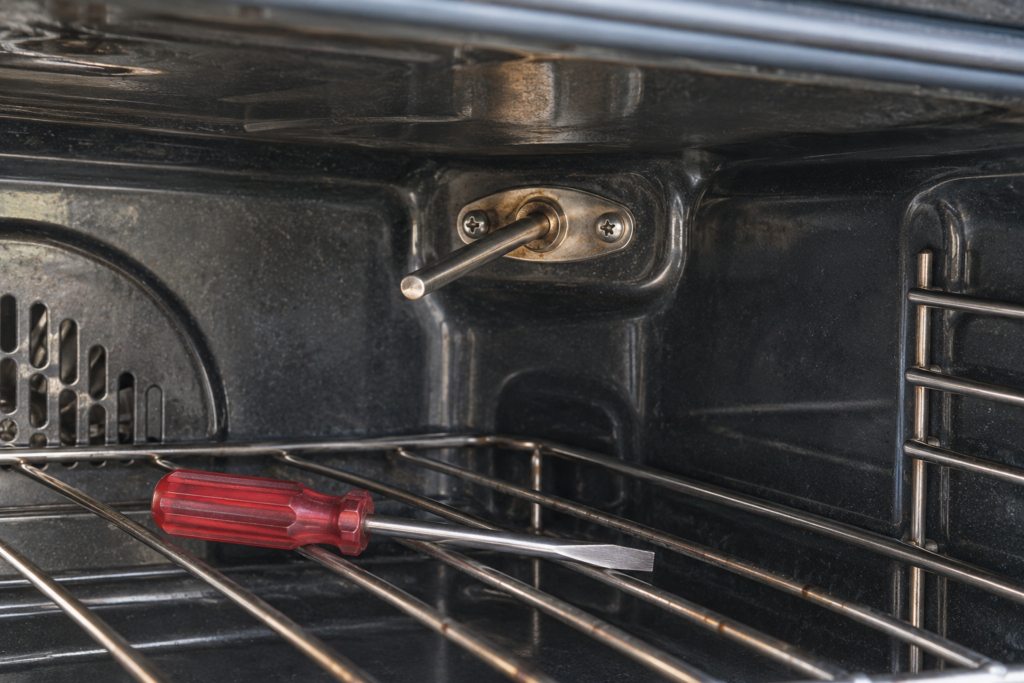
On a freestanding electric range the probe sits on the back wall of the cavity and is held by two screws, so the job is short. The practical advice for a wall oven is to ask the technician before the visit whether the quote assumes the oven has to come out of its cabinet, because that is where a surprise most often appears.
Before You Pay for a New Sensor
An oven that heats but cooks at the wrong temperature, with no code at all, is a different case. Here is a short list of cheap checks to make before a part is ordered.
- Put an oven thermometer on the center rack — preheat to a set point, wait twenty minutes and compare, so you know how far off the oven really is.
- Look at the probe — a bent or shifted probe, or one touching the wall, can read wrongly even when it is electrically fine.
- Write down the exact code and when it appears — a code at power-on and a code that appears after twenty minutes point at different parts.
- Ask for the part and labor split — a sensor is one of the cheapest parts in an oven, so a quote that is mostly parts deserves a question.
When the Sensor Is Not the Answer
If the probe tests good and the wiring is intact, the board's sensor input is the next suspect, and that is where the quote changes character. A control board starts from $250, and on an older wall oven that figure invites a comparison with a new unit, which our is it worth repairing a Whirlpool oven guide handles. If the oven is simply not heating and no code shows, oven not heating covers the other causes.
The oven repair page lists what a visit covers. You can book a diagnostic visit or send us the code and the model number first so the technician arrives with the right part.