 Denys Mitchell
Key Takeaways
- The drum support system — rollers, belt and sometimes a rear bearing — carries the full weight of a wet load and wears continuously by design.
- A rumble that tracks with drum speed points at worn rollers; a squeal that varies with belt tension points at the belt or idler pulley.
- A true bearing failure tends to be louder and more constant, often with detectable play when the drum is rocked by hand.
- Any of these repairs starts with removing the back panel, which is why more than one worn part is often replaced in the same visit.
- Drum support work starts from $220, with roller and belt jobs at the lower end and a full bearing replacement toward the higher end.
The Bottom Line
Listen for how the noise tracks against drum speed and belt tension before assuming the most expensive part has failed. Rollers and belts fail more often than the bearing itself, and cost considerably less to replace.
A rumble, a squeal, or a rhythmic thump that gets louder as a load of towels tumbles almost always leads to the same question: what is a Whirlpool dryer drum bearing replacement cost, and is it actually the bearing? The drum support system on a Whirlpool dryer is a small group of parts that all fail with roughly the same symptom, and telling them apart before calling for service is what keeps the repair on the lower end of the range rather than the higher end.
| Symptom | Likely part | Relative cost |
|---|---|---|
| Rumbling that changes with drum rotation | Drum support rollers | Lower |
| Squealing that changes with belt tension | Drive belt or idler pulley | Lower |
| Constant grinding, drum feels loose | Rear drum bearing | Higher — more disassembly |
| Drum will not turn, motor hums | Belt off track, or motor coupler on some models | Lower |
What Does a Dryer Drum Bearing Actually Do?
On a front-load dryer, the entire weight of a wet load rides on a support system rather than being centered on a shaft the way it would be on some other appliance designs. That support is usually a set of rollers at the back, sometimes paired with a rear bearing depending on the model, and the whole assembly is what lets the drum spin smoothly while carrying a full, unbalanced, wet load hour after hour. It is a wear part by design — it takes load and friction continuously, and it eventually wears down regardless of how the dryer is used.
What makes drum support noise tricky is that several different worn parts produce a similar sound from the laundry room, and only opening the back panel tells them apart with certainty.
Front-load and top-load Whirlpool dryers reach this area slightly differently, though the underlying parts are similar. On most front-load models the back panel comes off directly to expose the rollers and bearing; on some top-load designs the drum has to be lifted out through the top rather than the back. That difference affects labor time more than it affects which part is likely worn, since load, moisture and years of use wear these parts down the same way regardless of cabinet layout.
Is a Noisy Dryer Always the Bearing?
No — a bearing is only one of three or four parts that produce a similar noise, and it is usually not the first one to fail. Worn support rollers are more common and cheaper to replace than a full bearing job, and they produce a rumble that tracks directly with drum rotation speed. A worn or glazed drive belt produces more of a squeal that changes with belt tension rather than drum speed specifically. A true rear bearing failure tends to be louder, more constant, and often accompanied by a drum that feels slightly loose when you push on it by hand with the dryer off.
- Listen for pitch changing with drum speed — that points at rollers rather than the belt.
- Listen for squealing that varies as the load shifts — that points at the belt or idler pulley.
- Check for looseness by hand with the dryer unplugged, gently rocking the drum — real play points at the bearing.
- Note when the noise started relative to a specific event, like a very heavy or unbalanced load, which can accelerate roller wear.
- Run the dryer briefly empty and listen without the sound of tumbling clothes masking it, if it is safe to do so on your model.
- Check whether the noise is constant or intermittent — a bearing that has fully failed is usually constant, while early roller wear can come and go with load size.
What Does the Repair Actually Involve?
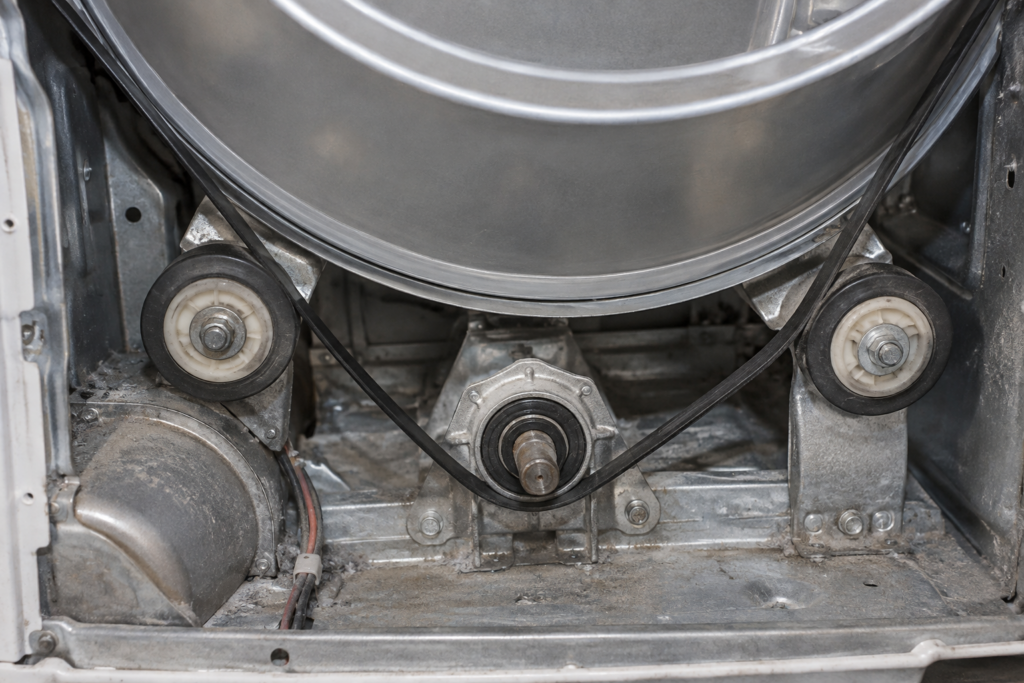
Any of these repairs starts the same way: the back panel comes off and the drum is supported or partially removed to access the rollers, belt and bearing area. That shared first step is why a technician diagnosing a roller problem will often flag early bearing wear at the same visit — once the drum is out, it costs little extra time to inspect everything in that area rather than just the specific part suspected.
- Back panel removed to expose the drum support area.
- Drum supported or lifted clear depending on the specific fault.
- Worn rollers, belt or bearing replaced — often more than one at once, since they wear on a similar timeline.
- Drum reseated and belt retensioned before the panel goes back on.
- Test run with the panel off to confirm the noise is gone before final reassembly.
- Panel replaced and a full cycle run to confirm the repair before the visit ends.
This is also why a roller replacement and a full bearing job land at different points on the same cost range rather than being priced identically — the bearing job typically involves more of the drum coming apart. A belt or idler pulley job usually sits at the lower end of the range too, since neither part requires fully removing the drum the way a bearing replacement does.
How Much Does a Whirlpool Dryer Drum Bearing Replacement Cost?
Drum support work on a Whirlpool dryer starts from $220, with rollers and belt work generally at the lower end of that and a full bearing replacement toward the higher end. That figure reflects labor more than parts cost, since the rollers and belt themselves are inexpensive — the time is in accessing them safely. The final price is always confirmed after an on-site diagnosis, with a written estimate before any work begins, which is also the point where a roller job and a bearing job get priced separately rather than guessed at over the phone.
Our broader Whirlpool dryer repair costs guide covers the full range of dryer repairs for comparison, from this mechanical drum work to the electrical and heating side of the machine, and if the dryer is also failing to heat alongside the noise, our guide to a Whirlpool dryer not heating covers that separate symptom.
Whether this repair is worth doing at all depends partly on the dryer's age and what else has needed attention recently, the same question our is it worth repairing a Whirlpool dryer guide walks through more generally. Drum support work on a dryer that is otherwise sound is almost always worth doing, since the parts themselves are inexpensive and the noise only gets worse with continued use.
Getting an Accurate Diagnosis
None of these three parts are reliably told apart by sound alone with full confidence, and opening the back panel is not a casual homeowner project on most models. Our Whirlpool dryer repair service inspects the whole drum support area in one visit rather than guessing at a single part in advance.
A diagnostic visit starts from $89, applied toward the repair if you proceed. Book a visit and describe when the noise happens, or send us the details and we will tell you which of the three likely parts is involved before a technician arrives.