 Denys Mitchell
Key Takeaways
- F1 and F2 are the same cavity thermistor failing in opposite directions — open and shorted — and both disable the magnetron on purpose.
- F3 is the membrane touch panel, and it usually announces itself with phantom beeps or dead keys before the code appears.
- F7 is a board-to-board communication fault; a two-minute power cut clears it when the cause was a surge, and it returns when the cause is hardware.
- PF only reports a power outage and is harmless, but PF with no outage in the house points at the circuit feeding the microwave.
- F9 is a door interlock fault and is the one code to stop at immediately — never bypass or wedge a door latch.
The Bottom Line
Read the code as the name of one circuit, not as a general fault: thermistor, keypad, board link or door switch. Everything except PF earns a proper diagnosis, and F9 earns one before the microwave is used again.
An over-the-range Whirlpool microwave has no service manual taped inside the door, so when the display drops the cook time and shows a letter and a number instead, most owners are left guessing. The good news is that the codes are short and specific. Each one names a single sensor, switch or board, and knowing which one it names tells you immediately whether this is a two-minute reset or a service call. The whirlpool microwave error codes below are the ones used across the WMH, WMC and WML series sold in American kitchens.
| Code | What the control is reporting | Where it points |
|---|---|---|
| F1 | Cavity thermistor open | Temperature sensor circuit, magnetron disabled |
| F2 | Cavity thermistor shorted | Same sensor, failed the other way |
| F3 | Keypad or touch pad fault | Membrane panel or its ribbon connector |
| F5 | Humidity sensor fault | Sensor cook circuit only |
| F7 | Control board communication error | Main board and secondary board disagree |
| F9 | Door switch or latch fault | Interlock switches in the door frame |
| PF | Power failure or outage detected | Clock only, usually harmless |
| SE | General sensor error | Sensor input the board cannot classify |
F1 and F2: The Cavity Thermistor
These two codes describe the same part failing in opposite directions. The cavity thermistor is a small temperature sensor that lets the control know how hot the oven cavity is getting. F1 means the circuit reads open, as though the sensor were unplugged. F2 means it reads shorted, as though the two wires were touching.
In both cases the board disables the magnetron, which is the correct and intentional response: without a trustworthy temperature reading, the microwave has no way to know whether the cavity is overheating. A hard reset clears the display, but on an F1 the code comes straight back on the next cook attempt if the sensor really has failed. Our page on the Whirlpool microwave F1 error walks through what a technician checks first.
F3: The Panel Thinks a Button Is Held Down
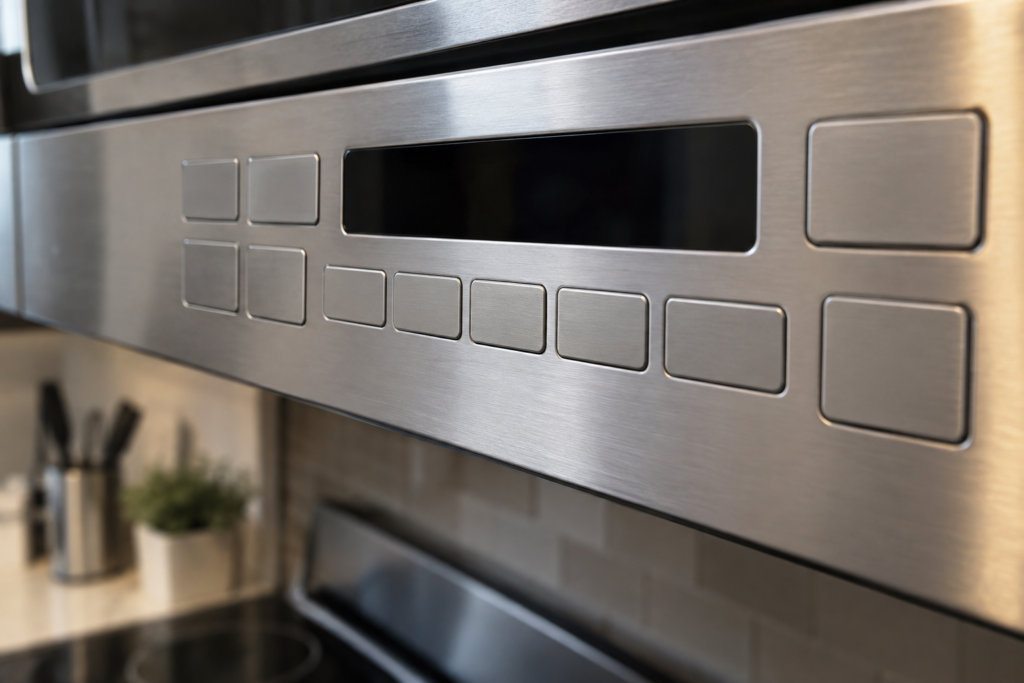
F3 is a keypad fault, and it usually announces itself before the code appears. The classic pattern is a microwave that starts beeping on its own, refuses a keypress that worked yesterday, or registers a number twice. Behind the plastic overlay is a membrane switch panel, and heat and steam from the cooktop below it are what eventually kill it.
- Wipe the panel dry first. Moisture trapped under the overlay can bridge a contact and imitate a stuck key.
- Cut power at the breaker for two minutes. That clears a latched reading rather than masking a failed panel.
- Note which keys misbehave. One dead zone points at the panel; the whole board dead points somewhere else.
- Do not pry the overlay off. The ribbon tail underneath tears easily and is not sold separately.
F7 and SE: The Boards Stop Agreeing
F7 is a communication fault between the primary control board and a secondary board. It is not a sensor reading at all — it means two pieces of electronics that should be talking have stopped. A two-minute hard reset clears F7 when the cause was a transient power event, such as a brownout or a surge from the range hood circuit. When the fault is in the hardware, the code returns and the microwave should stay unused until it is resolved, because uncoordinated magnetron operation is exactly what the interlock design exists to prevent. The full picture is on our Whirlpool microwave F7 error page.
SE is the catch-all. The board has a sensor input it cannot classify, which in practice means it is worth reading as a prompt to look for the failure rather than as a diagnosis. Treat SE the way you would treat F1 or F5: note what the microwave was doing when the code appeared, because that context is what narrows it down.
PF Is Normal, F9 Is Not
PF simply says the microwave lost power. After an outage or a tripped breaker, PF on the display means nothing worse than a clock that needs setting. If PF appears without any outage in the house, the circuit itself is worth attention — a loose neutral or a failing outlet behind the unit produces exactly this symptom.
F9 is the opposite. The door interlock switches confirm to the control that the door is physically closed before the magnetron can fire. When the board sees an implausible combination from those switches, it posts F9 and stops. Never work around a door switch fault, never tape or wedge a latch, and do not run the unit with F9 showing. This is the one microwave code that is a safety matter before it is a repair question.
Working Through a Code Without Guessing
- Write the code down exactly. F5 and SE point at different circuits and get confused with each other constantly.
- Cut power at the breaker for two full minutes. Unplugging is fine on a countertop unit; an over-the-range model is usually hard to reach.
- Restore power and try one short cook cycle with a cup of water inside, never empty.
- Watch when the code returns. Immediately on the cook attempt points to hardware; days later points to the power supply feeding the unit.
- Stop at F9 and at any burning smell. Those are not codes to experiment with.
One more pattern worth knowing: on a combination wall oven and microwave, a code on the microwave half does not tell you anything about the oven half. If the oven is also misbehaving, read our guide to a Whirlpool oven that will not heat separately.
Getting It Checked
Microwave repair is different from other appliance work in one respect: the high-voltage capacitor inside holds a lethal charge long after the unit is unplugged, and it must be discharged by someone who knows how. Nothing in this article asks you to open the cabinet, and nothing should. Our Whirlpool microwave repair service covers the sensor circuits, the door interlocks and the control boards.
Board and sensor work on these units starts from $140, and a diagnostic visit starts from $89. The final price is confirmed after the on-site diagnosis, and you get a written estimate before any work begins. Book a visit or send us the code you are seeing and we will tell you whether it is worth a service call at all.