 Denys Mitchell
Key Takeaways
- Whirlpool induction cooktops use seven codes, and LOC and PAN are not malfunctions — they report the control lock and pan detection respectively.
- E0 is a power supply issue and deserves caution, since induction cooktops draw more concentrated current than radiant or gas models.
- F1, F47 and F-CT all describe faults in the systems that regulate power to the induction coils and should stop use of the affected zone.
- F2 is specifically the touch control circuit, and cleaning dried spill residue off the panel resolves a meaningful share of occurrences.
- Spill residue and blocked ventilation cause a large share of these codes, making cleaning habits the cheapest prevention available.
The Bottom Line
Treat LOC and PAN as normal operation, not faults. Treat F1, F47, F-CT and a repeating E0 as reasons to stop using the affected zone and get a proper diagnosis rather than resetting repeatedly.
Whirlpool induction cooktop error codes look sparser than the F-and-E pairs on a washer or a dryer, and that is deliberate — an induction surface has fewer moving parts to report on, but the parts it does have are more electronically involved than a coil burner. Seven codes cover current models, and knowing which of them is a nuisance and which one means stop cooking on that zone is the entire point of this guide.
| Code | What the control detected | Safe to keep using? |
|---|---|---|
| F1 | Control board fault | No |
| F2 | Touch control error | No — panel may not respond correctly |
| F47 | Communication error | No |
| E0 | Power supply issue | No |
| F-CT | Cooktop sensor fault | No |
| LOC | Control lock active | Yes — not a fault |
| PAN | Pan detection issue | Yes, once a compatible pan is placed correctly |
What Does LOC Mean on a Whirlpool Induction Cooktop?
LOC means the control lock is active, and it is the one code on this list that is not a malfunction at all. Most panels clear it by pressing and holding the lock icon for three to five seconds. LOC engaging on its own, with nobody having touched the lock control, is a different situation — that pattern points toward a touch panel that is registering phantom presses, which is closer to an F2 fault than to a simple lock.
PAN behaves similarly in that it is not a hardware failure by itself. An induction element only heats when it detects ferromagnetic cookware sitting flat and centered on the zone. PAN means the element cannot confirm that condition — the pan is the wrong material, too small for the zone, or not seated flush.
What Does E0 Mean on a Whirlpool Induction Cooktop?
E0 reports a power supply issue, and it is worth treating with more caution than a routine code. An induction cooktop draws considerably more current at a single point than a comparable radiant or gas cooktop, because the induction coils and their driving electronics are a heavier electrical load concentrated in less space. E0 means the unit is not receiving power the way it expects to, which can point at the home's circuit, the connection at the cooktop, or the internal power supply board itself — and only a proper diagnosis tells those apart.
- Check for a tripped breaker before assuming anything inside the cooktop has failed.
- Note whether E0 affects every zone or just one. Every zone points at the incoming supply; one zone points at that zone's own circuit.
- Do not reset repeatedly and keep cooking if E0 keeps returning — an intermittent power fault is not one to work around.
- Have the connection at the cooktop checked if the home wiring tests fine — a loose high-current connection is a heat risk on its own.
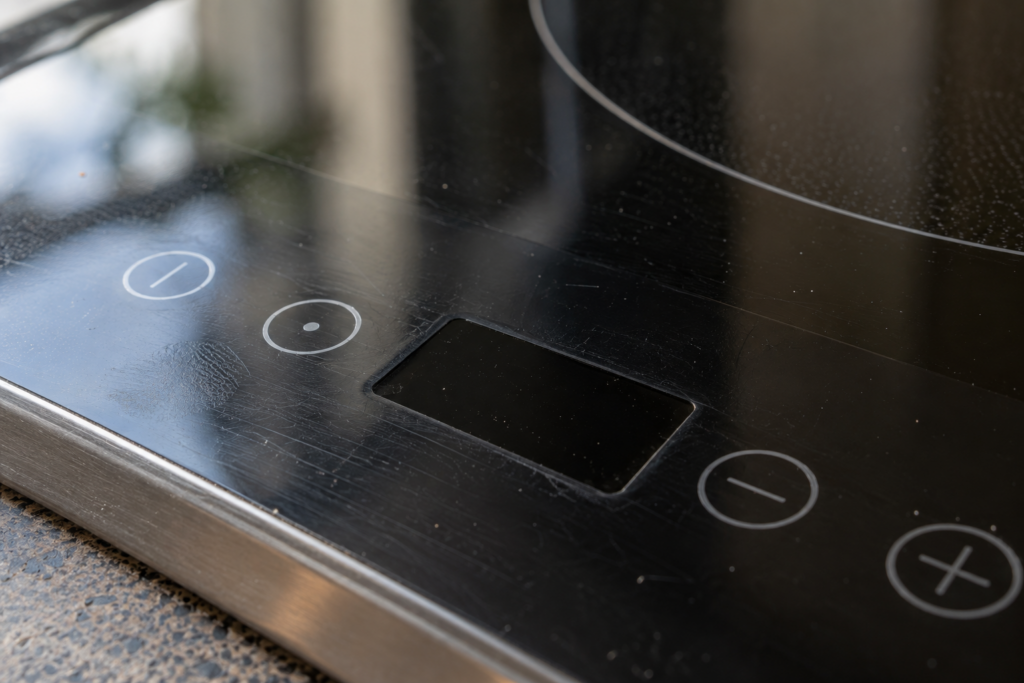
F1, F47 and F-CT: The Board and Sensor Codes
F1 is a control board fault — the central electronics that manage every zone at once. F47 is a communication error, meaning two boards inside the unit that should be exchanging data are not, which is distinct from F1 in that the boards themselves may be individually healthy. F-CT is a cooktop sensor fault, typically a temperature sensor used to protect the glass surface and the electronics beneath it from overheating.
All three of these justify the same response: stop using the affected zone, and do not attempt to reset past them repeatedly. Unlike a simple touch-panel glitch, these three describe faults in the systems that regulate how much power reaches the induction coils, and an induction coil running without proper regulation is a genuine overheat risk to the glass surface and to whatever is sitting on it.
Is F2 Always a Touch Panel Problem?
Yes — F2 specifically names the touch control circuit, distinguishing it from F1's broader control board fault. The most common real-world trigger is spilled liquid that has dried into a thin film across the capacitive strip, which the panel can register as a continuous touch. Cleaning the surface with the cooktop off, then powering back on, resolves a meaningful share of F2 occurrences without any part replacement at all.
- Power the cooktop off completely at the breaker, not just at the control panel.
- Clean the entire control strip with glass cleaner, including the edges where spills collect.
- Dry it fully before restoring power — residual moisture reproduces the same symptom.
- Note whether F2 returns immediately on power-up. Immediate return after a proper cleaning points at the panel itself rather than residue.
Cleaning Habits That Prevent Most of These Codes
A surprising share of induction cooktop codes trace back to spills and residue rather than component failure, which makes cleaning habit the cheapest prevention available.
- Wipe spills while the surface is warm, not hot — baked-on residue is what eventually works into the touch strip.
- Use a dedicated glass cooktop cleaner rather than an abrasive pad that can scratch the surface.
- Check the pan base for grit before every use — debris trapped under a pan can affect pan detection over time.
- Keep the ventilation area beneath the cooktop clear if the unit has a built-in cooling fan, since restricted airflow stresses the same electronics that raise F1 and F47.
For symptoms unrelated to a code — a zone that will not heat at all with no fault showing — our guide to a Whirlpool oven not heating covers the adjacent built-in cooking appliance, though a standalone cooktop and a wall oven do not share a control system.
Should I Keep Cooking With Any of These Codes Showing?
Only with LOC and PAN — every other code on this list means stopping the affected zone until it is checked. That distinction is worth repeating because it is the single most useful rule of thumb this whole guide offers: a code that reports the panel is locked, or that a pan is not detected correctly, is telling you the cooktop is working exactly as designed. A code naming a board, a sensor, or the power supply is telling you the opposite — that something in the system regulating heat delivery is not behaving the way it should, and continuing to cook on that zone removes a layer of protection you would otherwise have.
This same caution applies whether the cooktop is a few months old or approaching the end of its typical service life. Our Whirlpool cooktop repair or replace guide covers how to weigh a board or sensor repair against the cooktop's overall age once a technician has confirmed which part is actually at fault.
When to Call a Technician
Cleaning the surface and the control strip is safe, useful homeowner work. The control board, the communication link between boards, the sensor circuit and the internal power supply sit behind the glass and are not a homeowner repair, particularly given the current these units carry. Our Whirlpool cooktop repair service covers the full list above.
A diagnostic visit starts from $89, and board or sensor repairs are generally quoted from that same visit rather than a flat number in advance, since the specific board involved varies by model. The final price is confirmed after the on-site diagnosis, with a written estimate before any work begins. Our broader appliance diagnostics visit is the right starting point if you are not yet certain the cooktop is the source of the issue. Book a visit or send us the code and whether it affects one zone or the whole cooktop.